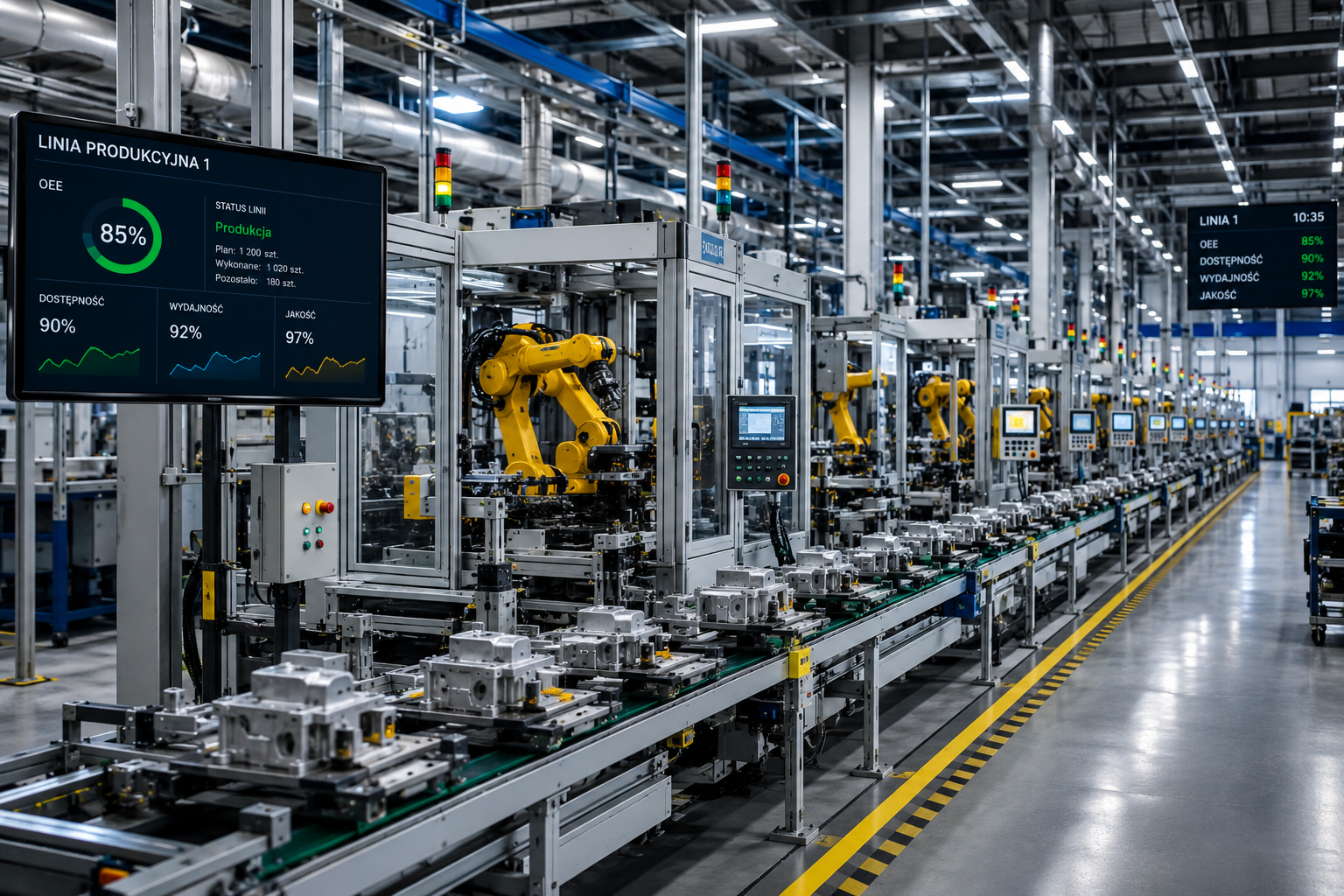
When a manufacturing plant sees its real OEE for the first time – not the one from the shift supervisor’s spreadsheet, but the one built on data pulled from the machines every second – the reaction is almost always the same. Silence, then a question: “so why did we think we were running at 82%?”. The answer fits in three letters. MES.
In 2026, the MES system stopped being a tool reserved for large corporations. It has become the foundation of manufacturing digitalization in mid-sized companies, and increasingly in smaller ones too. Without it, the digital transformation of a plant stalls at digitizing invoices and paper reports. With a well-implemented MES, a company gains something money cannot buy in any other form: alignment between what it plans and what actually happens on the shop floor.
What is an MES system
A Manufacturing Execution System (MES) is software for supervising, tracking, documenting, and controlling the production process in real time – from raw material to finished good. In the ISA-95 standard, MES sits at level three (Manufacturing Operations Management), mediating between ERP (level 4) and SCADA and PLC (levels 1–2).
The simplest way to put it: ERP knows what and by when to produce. SCADA knows how a specific machine behaves. MES is the only system that knows what is happening across the entire shop floor right now – who is performing which operation, on which machine, with which raw material, with what quality result, and with what deviations from plan.
How MES drives digitalization – the concrete mechanisms
Manufacturing digitalization is not a software purchase but a change in how a company makes decisions – from experience-based and report-delayed to data-driven and real-time. MES plays a key role in that shift because it is the only system that converts physical shop-floor events into business data.
The first mechanism is paper elimination. Job cards, quality sheets, production logs – everything that lived in binders for decades moves to one digital layer. A worker sees the job on a tablet and confirms completion with a single tap, and the data is instantly available to everyone who needs it.
The second mechanism is automatic machine data acquisition. Where machines have PLC controllers, MES pulls data directly via OPC UA, Modbus, or MQTT – cycle counts, temperatures, operation times, error codes. The operator no longer reports producing 240 units – MES knows it to the second.
The third mechanism is standard enforcement. MES does not ask the operator whether they completed the quality check – it simply refuses to advance to the next operation until they do. The standard no longer lives on a poster on the wall; it lives inside the system flow.
The fourth mechanism is traceability. In a plant with a well-implemented MES, you can verify in a fraction of a second which raw material batch a defective part came from, who assembled it, with what machine parameters, and at what time. That is legal and reputational safety, especially in pharma, automotive, and food.
The fifth mechanism is the foundation for analytics and artificial intelligence. No data, no AI in manufacturing. No MES, no consistent, structured shop-floor data. Every predictive maintenance project and every machine-learning defect classifier starts with the same question – where do we get the data from?

How an MES system fits into manufacturing digitalization
Manufacturing digitalization is not a software purchase. It is a change in how a company makes decisions – from experience-based and report-delayed to data-driven and real-time. In that transition, MES plays a central role because it is the only system that converts physical shop-floor events into business data.
Digitization of production processes usually starts with simple things – production orders stop being printouts, shop-floor reports stop being paper cards, quality checks stop being notebook entries. That is everything MES does in its base layer. But real digitalization only begins when that data starts driving the process. The operator does not just enter a measurement on a tablet – the measurement triggers an automatic maintenance alert, adjusts the schedule, blocks a batch from shipment, or initiates a reweigh. That layer is precisely what MES builds, connecting the information layer with the decision and execution layers.
Thanks to MES, record-keeping can happen in real time directly from the shop floor. This not only eliminates paper notes and spreadsheets but also lets you capture data invaluable for business model assessment, cost forecasting, and root-cause analysis. All shop-floor data lands automatically in a single source, generating reports that are easy to analyze. Automated production becomes aware, flexible, and predictable at the same time.
How to implement MES – the path that works
The most common mistake is implementing without a prior process map. Digitizing existing chaos produces digital chaos. The proven path looks as follows.
Stage one is mapping information flows – identifying where data is created, who consumes it, and where it is incomplete. Conversations with shift supervisors and operators, not with the software vendor. Stage two is a single-department pilot, two to four months long, with a hard set of KPIs measured before and after. Stage three is plant-wide rollout with ERP integration – without it, MES lives in isolation, and gaps between plan and reality create as many problems as they solve. Stage four covers the advanced layers: APS for scheduling, CMMS with a predictive module, and executive dashboards.
The keys to success are a careful plan, an experienced implementation partner, and full top-management support. Without that last element, even the technically best project bogs down at the operator level, where people “have no time to enter data”.
If you’re wondering whether an MES system is the right next step in digitalizing your production, give us a call and we’ll talk it through
FAQ
What is an MES system?
Software for managing, monitoring, and controlling production execution in real time. Specifically, it connects the planning layer (ERP) with the execution layer (machines, operators) and thereby forms the foundation of manufacturing digitalization.
What is the difference between MES and ERP?
ERP answers the question what and when to produce, in a horizon of weeks and months. MES, on the other hand, answers how to execute production right here and right now, in a horizon of minutes and hours.
How much does an MES implementation cost?
Typically from tens of thousands of dollars for a single-department pilot to several hundred thousand for full integration in a mid-sized factory. Self-hosted models based on open source additionally reduce licensing costs.
Does a small company need an MES?
Yes, if it operates more than a dozen machines or has a few planners. Moreover, modern MES systems are modular – which means you can start with basic monitoring of one area and scale up gradually.